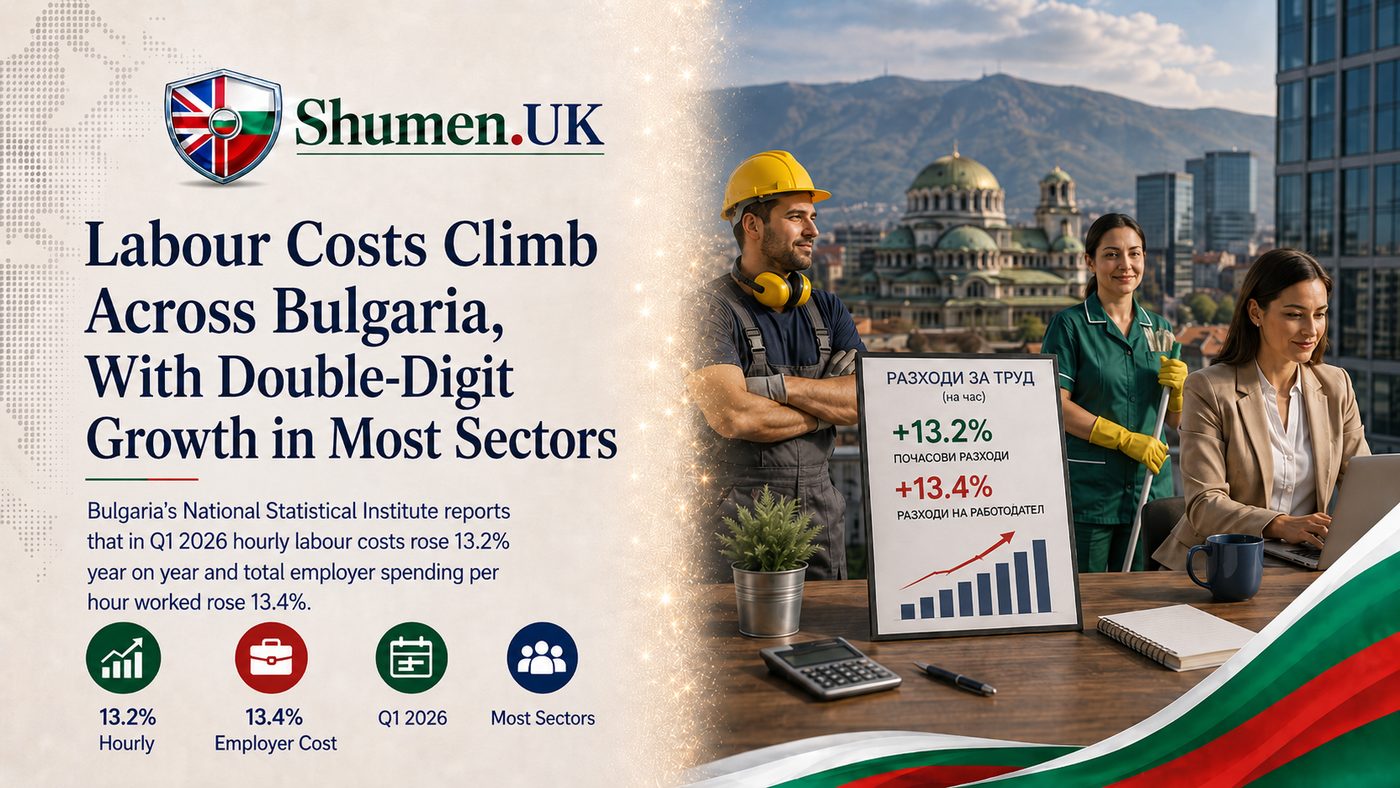
Bulgaria's National Statistical Institute has put a number on something every British expat who has hired a builder this year already suspected: labour is getting more expensive, fast. Hourly labour costs rose 13.2% in the first quarter of 2026 against the same period a year earlier, the NSI reported on 21 June. Add the employer's other on-costs and the total bill for an hour of work climbed 13.4%. That is not a blip. It is double-digit growth across most of the economy, in the same year Bulgaria swapped the lev for the euro.
The number is bigger than it looks
Here is the part that catches people out. When the NSI says "labour cost," it does not mean the wage. It means everything an employer pays to put someone to work for an hour: gross salary, plus social and health insurance contributions, plus allowances, social spending and the taxes attached to all of it. So if you run a guesthouse on the coast or a bar in a village and you are looking at a member of staff's payslip thinking the raise was modest, the figure that actually left your account rose faster. The 13.4% is the number that matters to anyone who signs the cheques.
Where the rises landed
The increase was uneven. Wage costs rose most slowly in real estate operations, at 7.7%, and fastest in the NSI's catch-all "Other activities" category, at 20.6%. Across the big blocks, industry saw total labour costs rise 14.1% and services 12.5%. Drilling down, the sharpest jumps were in public administration (20.3%), a residual "Other sectors" group (19.3%) and electricity, heat and gas (18.9%). For an expat, the line that earns attention is industry at 14.1%, because "industry" is where the trades sit: the builders, electricians, plumbers and renovation crews that anyone doing up a village house ends up paying.
Why wages are climbing
This is not happening in a vacuum. Bulgaria is short of workers. As Novinite reported in March under the blunt headline "Shrinking Population, Rising Wages," the labour market is being squeezed by long-running demographic decline: fewer working-age people each year chasing the same jobs, which pushes pay up regardless of how the wider economy is doing. At the same time public money is flowing in. The European Commission has just approved Bulgaria's fourth Recovery Plan payment, nearly a billion euros expected by July, which helps explain why public-administration labour costs are leading the table. Wages rising while the population shrinks is a structural story, not a one-quarter wobble, and structural stories do not reverse quickly.
What it means if you are British and living here
The cliche of Bulgaria as the place where everything is cheap has been wearing thin for a few years, and this is another seam splitting. The practical effects sort into three groups.
If you are renovating, the quote you were given last summer is probably no longer the quote. Industry labour up 14.1% means the human cost of a roof, a rewire or a bathroom has moved, and tradesmen who are in demand have every reason to charge it. Get fresh quotes, get them in writing, and assume the next one will be higher again.
If you employ anyone, a cleaner for the holiday let, bar staff, a property manager, budget for the full on-cost rather than the headline wage. A 13% rise in what you pay is a 13% rise whether you grant a raise or not, because the contributions move with the wage.
And if you are retired and living on a sterling pension, the squeeze is quieter but real. The gardener, the cleaner, the man with the van, the carer: those are services, and services labour rose 12.5%. A pension fixed in pounds does not rise 12.5%, so the gap between income and the cost of a helping hand narrows every year.
The bigger picture
None of this makes Bulgaria expensive by Western European standards, and the gap between a Bulgarian wage and a British one is still wide. But it is narrowing, and the direction of travel is the thing to hold onto. The money you budgeted for help around the house or work on the property is buying less of it than it did a year ago, and the NSI's numbers say that trend has another year of momentum behind it at least. Worth a look at the figures before you sign the next quote.