Bulgaria Ranks Second in EU for Monthly Growth
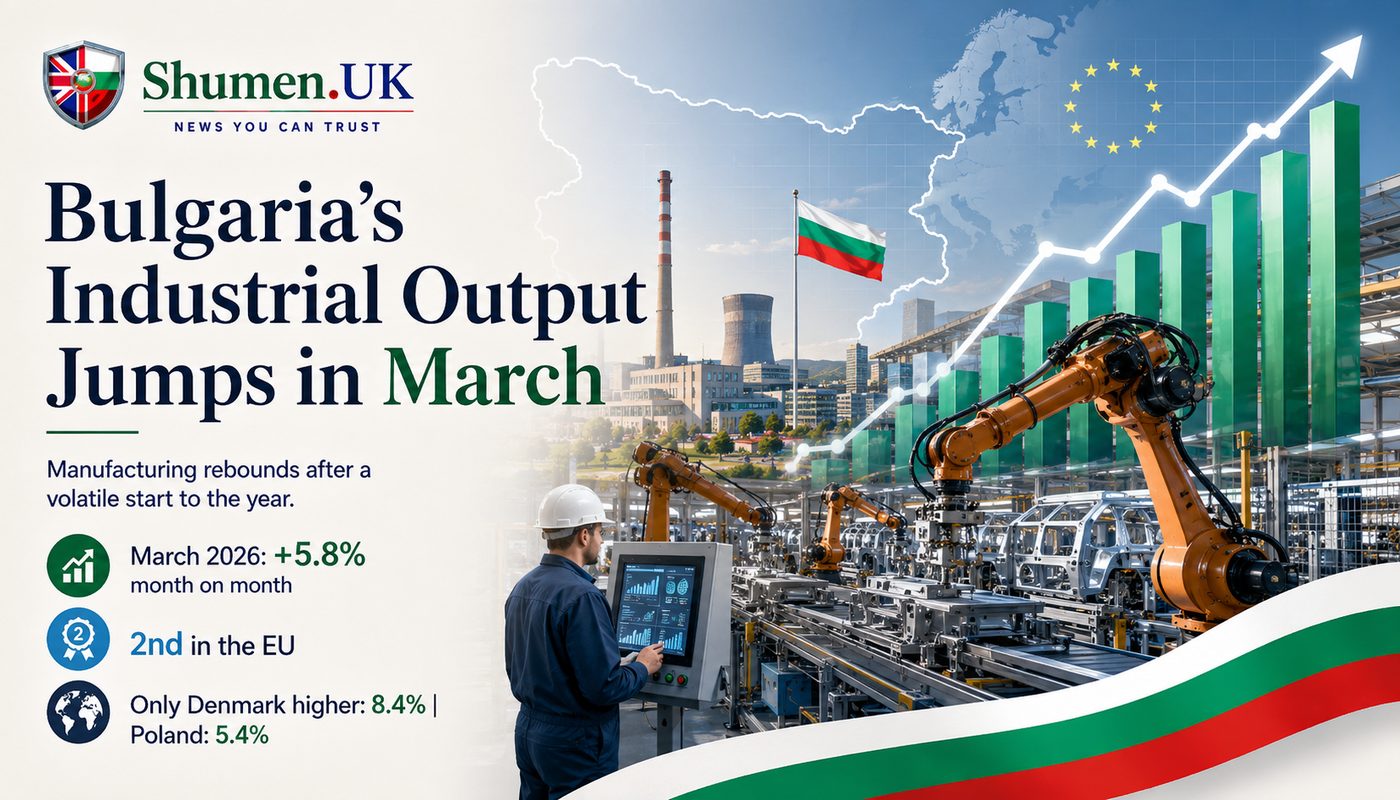
Bulgaria recorded a 5.8% increase in industrial production in March 2026 compared with the previous month, placing it second among European Union member states, according to Eurostat data reported by Novinite.com.
Only Denmark posted a higher monthly rise at 8.4%, followed by Poland at 5.4%. The result marks a sharp turnaround for Bulgarian manufacturing after a volatile start to the year, though monthly industrial figures swing about enough to make fortune tellers look reliable.
Across the eurozone, industrial output rose a modest 0.2% in March, matching February's pace but underperforming market expectations of a 0.3% increase. The EU as a whole saw a stronger 0.8% monthly gain, up from 0.2% the previous month.
It is worth noting that these figures come via Novinite.com's reporting of Eurostat data. No Bulgaria-specific sectoral breakdown was provided in the published figures.
Capital Goods and Durables Drive Expansion
The EU-wide growth was driven primarily by higher output in capital goods, intermediate goods, and consumer durables. Production in energy and non-durable consumer goods declined, limiting the overall pace of expansion.
At the other end of the scale, Belgium recorded a 3% decline in March, while Estonia and Sweden also saw decreases. Specific sectoral breakdowns for Bulgaria's performance were not detailed in the published data.
First Annual Increase Since Late 2024
On a year-on-year basis, Bulgaria's industrial production rose 4.8% in March 2026 compared with March 2025. This followed a sharp 8.7% drop in February and represents the country's first annual increase since November 2024.
The March figure also marks Bulgaria's strongest year-on-year rise since October 2022. That said, interpreting a single month's bounce against broader EU contraction requires a degree of caution. Monthly industrial data is notoriously fickle.
By contrast, the eurozone registered a 2.1% annual contraction in industrial production in March, while the EU as a whole declined by 1%, highlighting the uneven pace of recovery across member states.
What This Means for British Expats
Bulgaria's industrial rebound, if it holds, could affect employment patterns in manufacturing regions where some British expats work or invest. The sectors driving growth (capital goods, intermediate goods, consumer durables) align with industries where UK manufacturers often source components or seek supply chain partnerships.
For British exporters with Eastern European operations, Bulgaria's outperformance of several Western European economies in short-term industrial output suggests improving business conditions. UK firms supplying machinery, automotive components, or manufacturing equipment may find Bulgarian demand strengthening, assuming the March result proves more than a statistical blip.
British expats considering entrepreneurial ventures or business expansion in Bulgaria should note the divergence between Bulgaria's performance and broader EU contraction. This underscores varied economic conditions across the bloc, a factor worth weighing against Bulgaria's longer-term structural challenges.
The caveat remains substantial: one strong month does not override the volatility seen throughout early 2026, nor does it confirm Bulgaria has entered sustained growth. Monthly production figures are notorious for swinging wildly. British investors should treat this as encouraging context rather than a green light for immediate decisions.
What to watch next: whether April and May figures support the March trend, and whether Bulgaria's capital goods and consumer durables sectors maintain momentum while eurozone demand remains weak. The latter would be rather more impressive than a single month's spike.