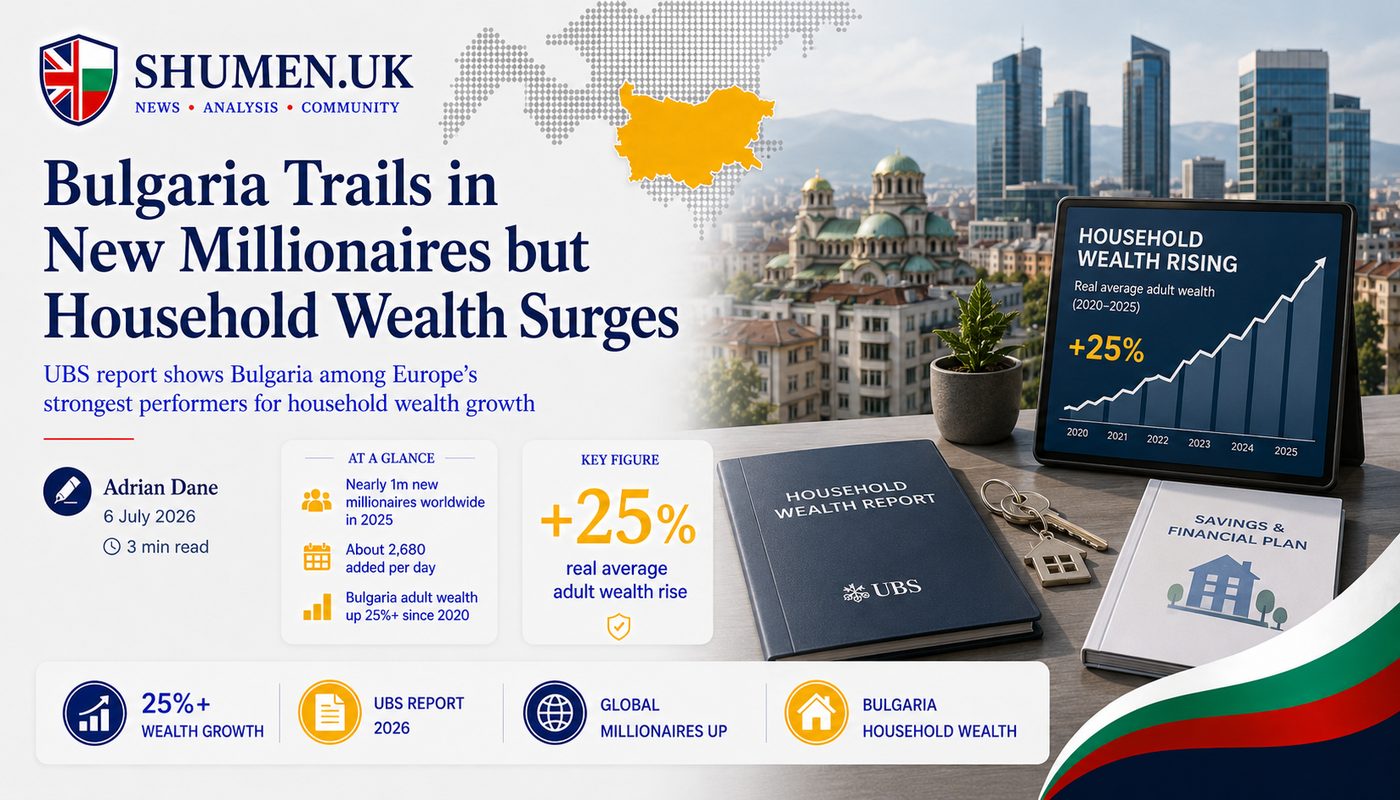
Bulgaria added few new dollar millionaires last year, but its households got measurably richer anyway. UBS's Global Wealth Report 2026, reported by Novinite on 13 July, found that real, meaning inflation-adjusted, average wealth per adult in Bulgaria rose by more than 25% between 2020 and 2025, one of the strongest five-year gains recorded anywhere in Europe.
Those two facts, UBS says, are not actually in tension. A country's millionaire count and its underlying household wealth move by different logic, and Bulgaria's numbers this year are about as clear an illustration of that gap as the report offers.
Where the New Millionaires Are
Worldwide, the number of people holding at least USD1 million in net assets grew by nearly one million in 2025, UBS found: an average of more than 2,680 new millionaires a day, or roughly 112 an hour. The United States drove most of that growth, adding 441,078 new dollar millionaires and now accounting for more than 40% of the report's estimated 57.5 million dollar millionaires worldwide.
Europe's biggest absolute gains were concentrated in the west. The UK added over 43,000 new millionaires, more than any other European country, working out to roughly 118 a day. France and Spain each added more than 32,000 (95 and 90 a day respectively), while Italy and Germany each gained more than 24,000 (67 and 66 a day). Western Europe as a whole now holds close to 15 million dollar millionaires, about a quarter of the global total.
Measured by growth rate rather than raw numbers, the picture shifts east. Lithuania led the world with an 8% increase, adding 921 new millionaires, followed by Turkey at 6.4%. Latvia, Hungary, Ireland, Poland and Greece all posted notable gains too.
None of the big five by absolute numbers, the US, UK, France, Spain, Italy and Germany, also tops the growth-rate table, and none of the growth-rate leaders appears among the absolute-numbers leaders either. That is not a coincidence: absolute rankings reward countries that already have large, wealthy populations, while growth-rate rankings reward smaller populations adding millionaires quickly off a low base. Bulgaria is neither a large wealthy population nor a country adding millionaires fast off a low base, so it shows up on neither list. The story here runs through a different number entirely.
The Number Bulgaria Actually Led On
UBS did single Bulgaria out, just not for millionaires. Between 2020 and 2025, real average adult wealth in the country rose by more than 25%, placing Bulgaria among Europe's strongest performers for household wealth growth over that five-year stretch. Croatia, Latvia and Norway posted similarly strong gains.
UBS's own explanation for the gap is worth reading in full, because it is the actual story here. The number of millionaires "does not provide a complete picture of a country's financial health," the bank noted, pointing instead to property values, home ownership, private pension savings, access to financial markets and investment tax policies as the factors that move household wealth even when the millionaire count barely shifts.
None of that shows up at the till in a Kaufland or in the queue at the notary's office. It shows up first in a spreadsheet in Zurich, filtered through property registries and pension records, long before it changes anything a person can point to on the street.
What This Means for British Expats
Three of UBS's named factors are things a British expat in Bulgaria is already exposed to directly, more so than the average reader of a global wealth report ever is.
Property is the obvious one. Home ownership is one of UBS's named drivers, and anyone who has bought a Bulgarian property since 2020 has a direct personal stake in whichever local price trend fed into this national average. Our guide to buying property in Bulgaria covers what that looks like in practice, from deposits to notary costs.
Private pension savings is the second factor, and it applies to any Brit who has moved a UK pension pot into a portable arrangement rather than leaving it untouched at home. Our pensions guide sets out how that process works and what to watch for.
The third factor, investment tax policy, is where Bulgaria genuinely stands out: a flat 10% rate applies to most personal and corporate income, among the lowest in the EU, and it is exactly the kind of structural advantage UBS's methodology would pick up in a rising household-wealth figure long before it shows up as a fresh crop of millionaires. The mechanics are in our taxes guide.
UBS names a fourth factor too: access to financial markets. Neither the bank's summary nor Novinite's write-up says what that means specifically for Bulgaria, so it is worth naming as an open question rather than guessing at it. Property, pensions and tax policy are the three factors with a clear, documented British-expat angle; this one currently is not.
None of this means the average Bulgarian household is suddenly wealthy in absolute terms. The country still trails the EU's wealthier members by a wide margin, and a 25% rise in real average wealth from a low starting point is a different thing from a 25% rise from a high one. What it does mean is that the levers UBS can actually explain, property, pensions and tax policy, are exactly the levers a British expat here already has a hand on.