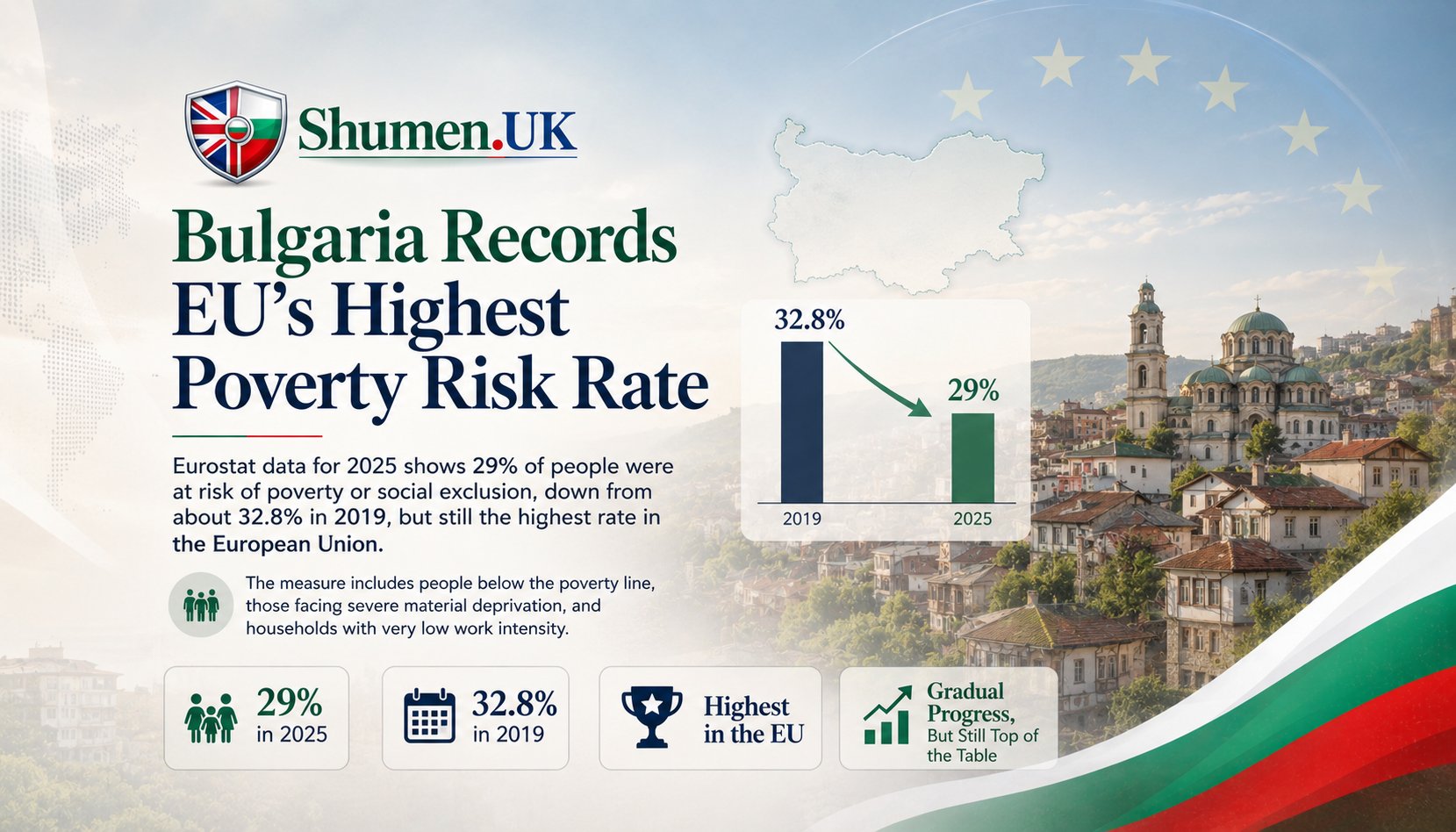
Bulgaria recorded the highest proportion of people at risk of poverty or social exclusion in the European Union in 2025, according to Eurostat data cited by Politico and reported by Novinite. The rate stood at 29%, down from about 32.8% in 2019.
The decline represents a reduction of 3.8 percentage points over six years. Over the past decade, the poverty risk level has fallen by nearly one-third. Despite the improvement, Bulgaria remains at the top of the EU ranking for this measure.
Czech Republic and Slovenia Lead
At the opposite end, the Czech Republic and Slovenia reported the lowest levels in the bloc, with rates of around 11.3% and 14.4% respectively. These figures place them significantly below the EU average and highlight the continued gap between member states.
Eurostat data also indicates that while Bulgaria has shown a gradual downward trend, some wealthier EU countries are experiencing stagnation or increases in their own poverty indicators. Source reporting does not specify which countries or provide detailed comparative data.
New EU Policy Framework in Preparation
The European Commission is preparing a new policy framework aimed at addressing poverty and social exclusion across the Union, according to source reporting attributed to Commission plans. The proposal is expected to be presented soon, with a focus on improving how existing resources are used rather than increasing funding.
These details have not been officially confirmed. The description below reflects reporting based on attributed Commission sources rather than published policy documents.
Brussels is expected to emphasise reforms in national social protection systems and labour markets, encouraging member states to better target social assistance and improve employment outcomes. The approach is designed to reduce inequalities through structural changes rather than additional EU budget allocations.
The Commission is also expected to require more detailed national action plans and introduce stricter mechanisms for monitoring progress. The aim is to ensure that member states deliver measurable results in reducing poverty through more efficient use of both national policies and European funds.
What This Means for British Expats
For British expats in Bulgaria, these poverty trends shape the broader economic landscape in practical ways. Nearly a third of the population facing material constraints affects consumer spending, wage levels, and the quality of public services.
British people running businesses in Bulgaria operate within an economy where purchasing power remains limited for a significant portion of the population. Those employing staff locally navigate a labour market shaped by these conditions. Property buyers and long-term residents experience the effects through infrastructure investment levels and the pace of economic development in their areas.
The new EU approach reflects Brussels' broader preference for structural reform over direct spending increases. Whether reforms in social protection and labour markets will meaningfully improve economic stability in Bulgaria remains an open question, particularly given the absence of increased funding.
Post-Brexit, British nationals in Bulgaria are outside the EU policy framework but remain affected by its outcomes. Economic stability in Bulgaria matters for the business environment, property values, and the overall quality of life that drew many Brits to the country. The gap between Bulgaria and the EU average remains substantial, and bridging it through reform alone represents a significant test of the Commission's strategy.
Background
The risk of poverty or social exclusion is a composite measure used by Eurostat that includes people living below the poverty line, experiencing severe material deprivation, or living in households with very low work intensity. It captures multiple dimensions of social disadvantage beyond just income.
Bulgaria's persistently high rate reflects a combination of factors including low wages, limited social protection, and regional disparities. While the country has made progress over the past decade, the decline has been gradual rather than dramatic, and Bulgaria continues to face challenges in addressing structural inequalities.