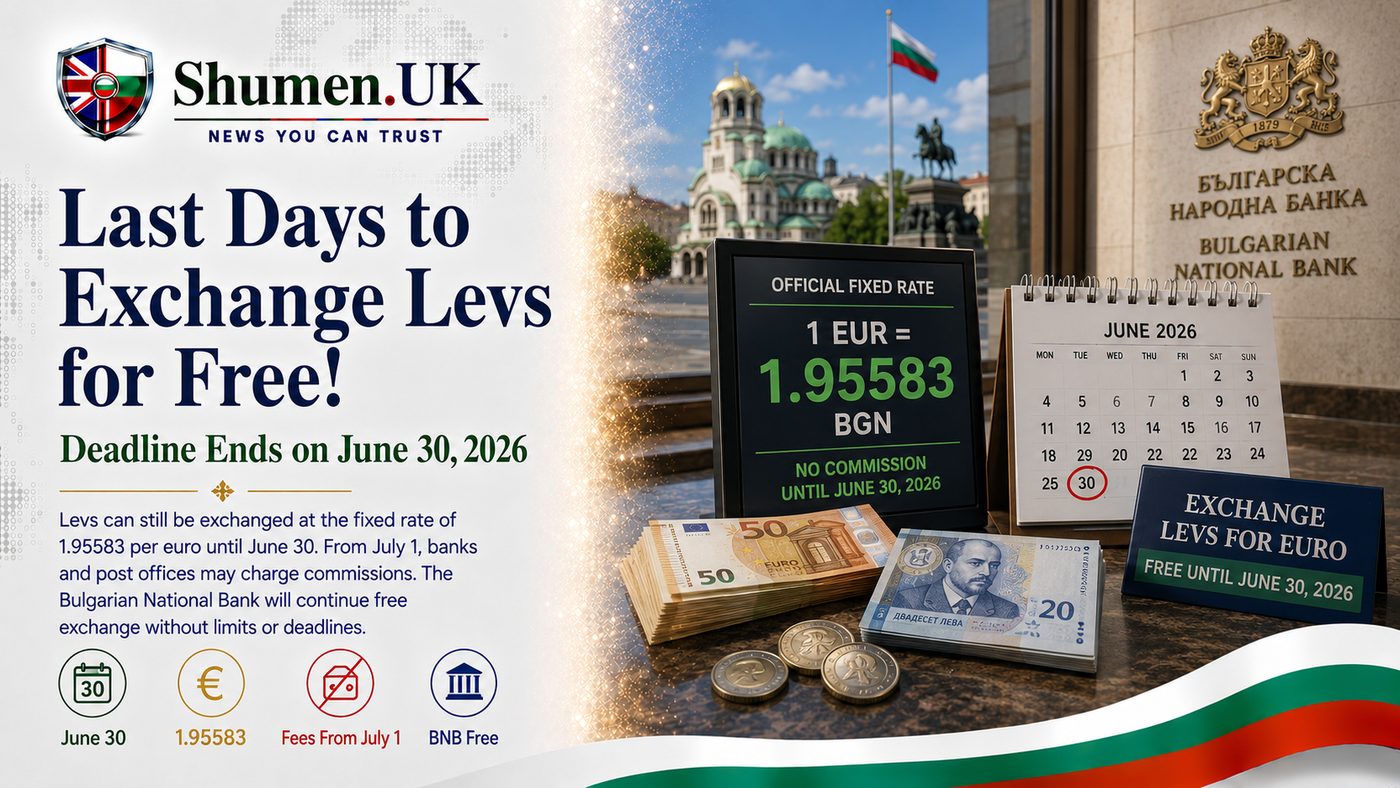
Bulgaria's grace period for swapping leftover leva into euros free of charge runs out on 30 June, and after that the favour stops being guaranteed. From 1 July, commercial banks and selected branches of Bulgarian Posts are allowed to start charging a commission on a conversion that has been free since the changeover, the Sofia News Agency reported, citing a press release from the exchange operator Tavex.
The mechanics are unchanged until the deadline. Leva are still converted at the fixed rate of 1.95583 leva to one euro, the same rate that has applied since Bulgaria joined the euro on 1 January 2026. The only thing that changes next week is who gets to add a fee on top.
Most British expats here have a small stash of leva tucked away somewhere: the tin on the kitchen shelf, the float in the glovebox, the deposit a landlord handed back in cash, the coins that never quite made it to the supermarket self-checkout. For six months that money has been easy to ignore. The clock on swapping it for nothing is now down to its final days.
What Actually Changes on 1 July
Until the end of 30 June, you can walk into a commercial bank or a participating post office and convert leva to euros at the fixed rate with no charge. The Tavex release frames this as the closing of the free-of-charge window, not a hard cut-off for the currency itself.
From 1 July, banks and post offices are permitted to apply a commission. That is worth reading carefully: the reporting says they will be allowed to charge, not that every branch will, or that fees will be uniform. Expect them to vary by institution, so if you are exchanging a meaningful amount it will pay to ask before you hand the cash over.
The one constant is the central bank. The Bulgarian National Bank will keep exchanging leva for euros free of charge with no limits and no deadline, the report states. That is the long-stop guarantee, and it mirrors what other eurozone members have done: a national central bank that swaps the old currency indefinitely while the high street quietly stops bothering.
Dig the Leva Out Before the Window Shuts
The practical takeaway is dull but real: find your leva now and bank them before next Tuesday. After 30 June the money is not lost, but the convenient route to converting it for nothing closes.
That matters because "free at the central bank forever" is less generous than it sounds. The BNB does this over the counter at its cash desks, which means Sofia or a regional cash centre, not the branch of whatever bank you already use down the road. For anyone outside the bigger cities, a special trip to a BNB counter to swap a jar of coins is the kind of errand that never actually happens. The free high-street option, the one that needs no special journey, is what disappears on 1 July.
If you are clearing out larger sums, it is also a sensible moment to make sure the notes you are holding are genuine and bankable before you queue, rather than discovering a problem at the counter.
The Travel Twist the Headline Buried
The Tavex release spends most of its energy not on the deadline but on summer travel, and there is a genuinely useful point folded into it. Adopting the euro has not ended the need to think about currencies, because plenty of popular trips from Bulgaria still cross out of the eurozone.
The operator reports steady demand for the Turkish lira, the Hungarian forint, the Polish zloty, the Czech koruna, the Bosnian convertible mark, the Serbian dinar and the Chinese yuan, with interest in the koruna rising on the back of Prague-bound holidays. Demand overall is broadly flat on last year, which the release reads as stable travel habits despite the currency switch.
"The introduction of the euro does not mean that Bulgarians stop thinking in currencies," Max Baklayan said in the release. "On the contrary, the summer season shows that when people travel outside the eurozone, they continue to orient themselves towards the local currency of the country they are going to."
For a Brit packing for Istanbul, Belgrade or Sarajevo, the live question is the same one the release raises but does not answer: euros in your pocket, local currency bought in advance, or just the card? The trap it hints at is dynamic currency conversion, the "would you like to pay in euros?" prompt at a foreign card terminal or cash machine. Saying yes hands the exchange rate to the merchant's payment processor, usually at a worse rate than your bank would give. The rule of thumb that actually saves money is to always choose to be billed in the local currency of the country you are standing in, and let your own bank do the conversion. Our money guide walks through the euro changeover and the card-fee pitfalls in more detail.
None of which changes the immediate job. The travel planning can wait until you have booked. The free lev swap cannot: that one has a date on it, and the date is 30 June.