Legislative Package Targets Retail Pricing
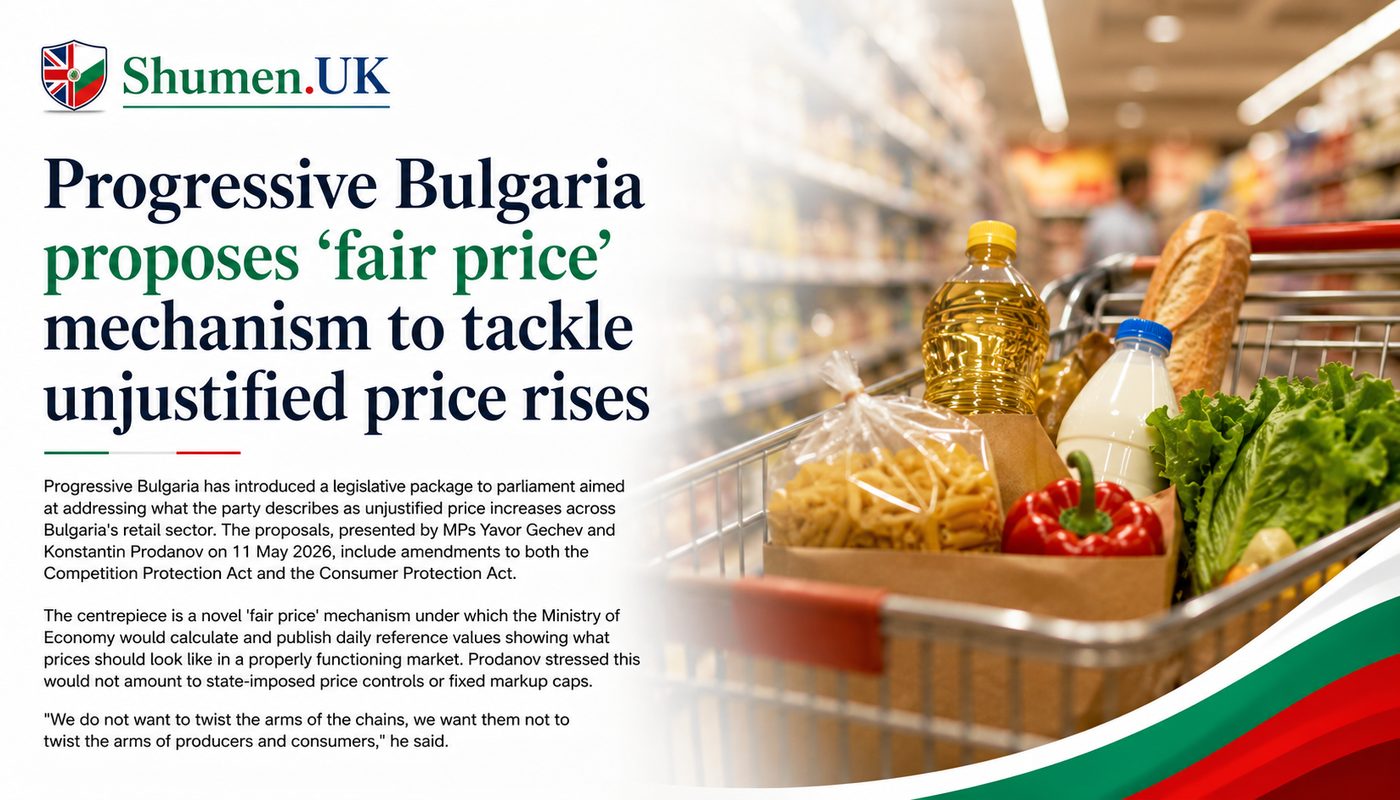
Progressive Bulgaria has introduced a legislative package to parliament aimed at addressing what the party describes as unjustified price increases across Bulgaria's retail sector. The proposals, presented by MPs Yavor Gechev and Konstantin Prodanov on 11 May 2026, include amendments to both the Competition Protection Act and the Consumer Protection Act.
The centrepiece is a novel 'fair price' mechanism under which the Ministry of Economy would calculate and publish daily reference values showing what prices should look like in a properly functioning market. Prodanov stressed this would not amount to state-imposed price controls or fixed markup caps. "We do not want to twist the arms of the chains, we want them not to twist the arms of producers and consumers," he said.
Expanding Unfair Trade Practice Rules
The existing list of 13 regulated unfair trade practices under the Competition Protection Act would expand to include more than 30 forms of unfair market behaviour. According to Gechev, the expanded list draws on findings from previous competition investigations and public complaints about retail and wholesale pricing.
The package also proposes creating a full supply chain traceability register, documenting every stage of production and distribution to improve transparency. "Bulgarian society believes that the prices we are seeing in chain stores, pharmacies, and different sectors of retail and wholesale trade are unjustifiably high," Gechev said, arguing that normal economic factors such as fuel costs, wars, or supply chain disruptions do not explain current price levels.
Joint Monopoly Position and Doubled Fines
Drawing on German competition law, the proposals introduce the concept of a 'joint monopoly position' to tackle situations where several companies hold enough collective market power to distort competition and influence prices, even without formal coordination.
The Commission for Protection of Competition would see its maximum fines doubled. Prodanov described the measure as primarily preventive. "We hope this will have a disciplinary effect," he said.
Euro Law Extended for Another Year
The so-called Euro Law, introduced during Bulgaria's euro adoption process, would be extended for another year. Under the extension, large retail chains with annual turnover exceeding €10 million would continue to report prices daily and justify any increases.
Prodanov argued that effects connected to Bulgaria's euro changeover, which took place on 1 January 2026, had not yet fully passed and that additional safeguards remained necessary during the transition.
What This Means for British Expats
British expats in Bulgaria may notice changes in retail pricing practices if the proposals become law. The daily price reporting requirements and published 'fair price' benchmarks could increase transparency around supermarket and pharmacy pricing, though the practical effect on household expenses remains to be seen.
The measures are particularly relevant during Bulgaria's euro transition period. British nationals living in Bulgaria and managing household budgets in euros may benefit from greater clarity around what constitutes fair pricing, though the legislation does not cap prices directly.
British businesses trading in Bulgaria or operating retail operations should note the proposed expansion of unfair trade practice definitions and the increased compliance burden around price reporting and supply chain documentation. No timeline for implementation has been announced, and reaction from retail trade associations and business groups is not yet available.
Market-Oriented Approach, Says Progressive Bulgaria
The MPs insisted the measures remain entirely market-oriented and said they were inspired by practices already used in several Western European countries. According to them, the reforms are intended to reduce pressure on household expenses and restore balance in the pricing of essential consumer goods.
Prodanov described the effort as part of a broader campaign against speculation during a period of economic strain. "The fight against speculation and an end to feasts during the plague are our main priorities," he said.
The proposals now face parliamentary debate. No timeline for passage has been announced, and whether the measures will be adopted into law remains uncertain.
FAQ
What is a 'fair price' under the proposed law?
The 'fair price' would be a daily reference value calculated and published by the Ministry of Economy showing what a product's price should be in a properly functioning market. It is not a price cap or fixed ceiling. The government would not legally prevent retailers charging more, but the published benchmark would provide transparency and a basis for enforcement of unfair pricing rules.
Would this affect all retailers in Bulgaria?
The daily price reporting requirements apply only to large retail chains with annual turnover over €10 million. Smaller businesses would not be subject to the same obligations, though the expanded unfair trade practice definitions and supply chain traceability register would apply more broadly across retail and wholesale sectors.
What is a 'joint monopoly position'?
Borrowing from German competition law, a joint monopoly position exists when several companies collectively hold enough market power to distort competition and influence prices, even if they do not formally coordinate with one another. The concept targets oligopolistic behaviour without requiring proof of explicit collusion.
When would these measures come into force?
No implementation date has been announced. The proposals must first pass through parliamentary debate and approval. If enacted, some measures such as the Euro Law extension and daily price reporting would likely take effect immediately, while others such as the traceability register may require a transition period for businesses to comply.