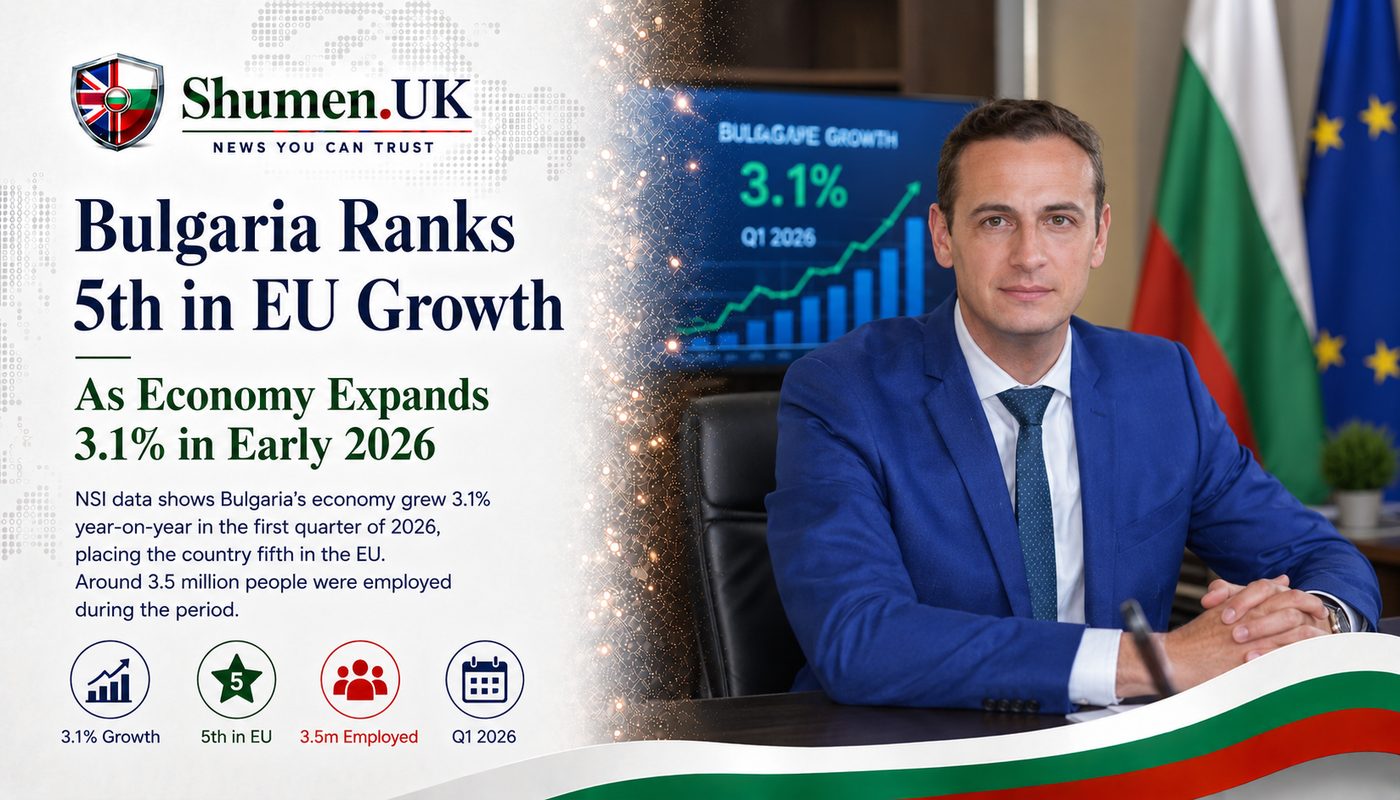
Bulgaria's economy expanded 3.1% year-on-year in the first quarter of 2026, according to figures released by the National Statistical Institute and confirmed by multiple external sources including SeeNews and the Irish Sun. Anyone tracking Bulgarian GDP data for investment or relocation purposes now has the official number. Anyone filling up at a petrol station in Shumen this spring has seen the economy's pulse in their own wallet.
Dr. Svilen Kolev, deputy chairman of the NSI, told NOVA NEWS that revised sectoral data pushed the growth figure up from earlier estimates. He also stated that Bulgaria ranks fifth among EU member states for Q1 growth, though no independent Eurostat or European Commission data has yet confirmed that exact ranking. The 3.1% figure itself is verified across multiple sources. The fifth-place claim rests solely on NSI's assessment and should be treated as such until EU-wide statistics appear.
Household Spending Led, Industry Contracted
According to Dr. Kolev and the NSI data, household consumption was the main driver, underpinned by increasing incomes. Novinite.com corroborated this in separate reporting, noting that Bulgaria continues to record some of the strongest private consumption growth in the EU during the post-pandemic period. The typical British expat grocery bill or restaurant spend sits within that consumption data. So does the uptick in Sofia café tables at lunchtime, and the Plovdiv retail park traffic on Saturday mornings.
Dr. Kolev noted that industry was the only sector registering a decline in value added, largely due to weaker export performance. Services, by contrast, now account for approximately 75% of total gross value added (NSI figures), covering trade, transport, logistics, finance, tourism, and information technology. Agriculture and industry represent a smaller share, reflecting long-term structural shifts driven by digitisation and changes in global supply chains rather than short-term fluctuations.
Gross value added in Q1 reached €23.83 billion at current prices, according to the NSI. Dr. Kolev stated that investment activity contributed positively, with both private and public spending playing a role, including funds linked to European recovery mechanisms and support programmes, though specific data on EU fund impact was not provided.
Employment Held Steady
Approximately 3.5 million people were employed during the quarter, according to Dr. Kolev. He stated that unemployment remains at historically low levels, indicating that the downturn in industry has not significantly affected overall employment. Independent third-party labour market data for Q1 2026 are not yet available to corroborate these points, but the NSI is Bulgaria's official statistical authority. British expats working in Bulgaria or running operations here have so far seen a stable labour market on the ground.
What This Means for British Expats
British businesses assessing Bulgaria as a market or operational base now have Q1 data showing resilient domestic demand and stable employment, even as exports softened. Services dominance matters if your business operates in IT, logistics, or tourism. The industrial contraction matters if you are in manufacturing or export-facing sectors.
Bulgaria is gradually converging toward average European income and GDP per capita levels, though it remains the lowest-ranked EU member state in the 2026 Wealth of Nations Index according to separate reporting from the Institute for Market Economy. Dr. Kolev concluded that sustained progress will depend on consistent policy efforts, improved competitiveness, and stronger institutional efficiency.
Practically, the 3.1% growth figure is now the baseline for anyone modelling Bulgarian market conditions in 2026. The fifth-place EU ranking claim awaits independent confirmation: treat it as NSI's assessment rather than settled fact until Eurostat publishes comparable data.