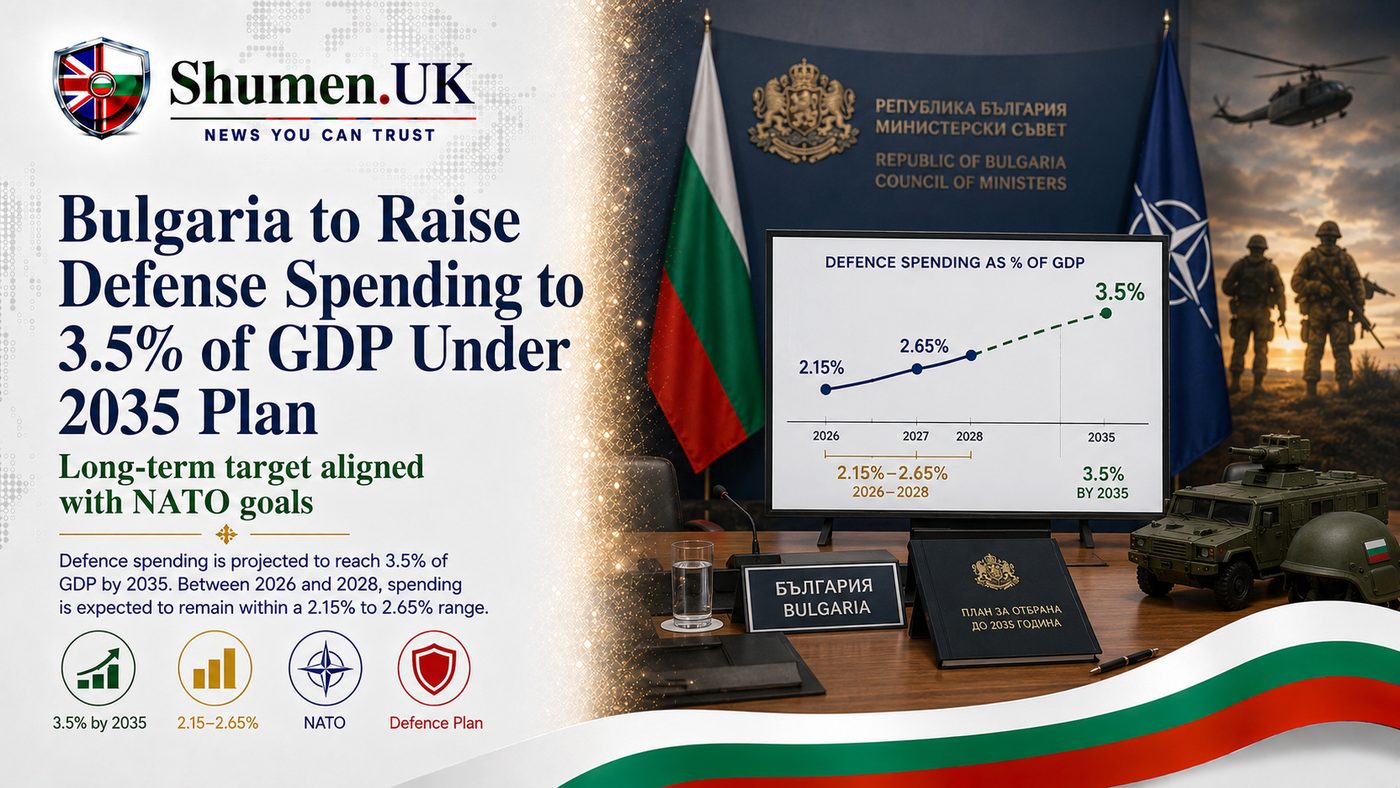
Bulgaria has published a long-term defense investment plan projecting roughly €19 billion in total spending by 2035, with €9 billion allocated directly to armaments procurement and military modernization. The strategy, confirmed by the Bulgarian government and reported by BNR, sets a target of 3.5% of GDP for defense expenditure by 2035, aligning with NATO commitments made at the alliance's Hague summit.
Anyone following the Brussels defense funding debates will recognize the gamble: Sofia is banking on the EU's SAFE loan instrument to underwrite a significant portion of the bill, but nobody knows if the mechanism will survive past 2030. It's the sort of planning horizon that looks bold on paper and precarious in a finance committee.
Phased Increase Through Three Stages
Between 2026 and 2028, the government projects defense spending will hold at 2.15% to 2.65% of GDP, covering personnel costs, operational maintenance, and existing international procurement commitments. That baseline keeps the lights on but leaves little room for new kit. (These specific figures come from the government's published plan and have not been independently confirmed in official budget documentation, so treat them as targets rather than carved-in-stone commitments.)
After 2028, spending climbs modestly, supported primarily by EU SAFE financing, a low-interest loan programme designed to fund European defense projects. During this phase, Bulgaria plans to acquire weapons systems and military platforms worth approximately €3.26 billion, to be introduced gradually by 2030. Whether those procurement schedules translate into actual deliveries or the usual delays is anyone's guess, though Eastern European defense acquisitions do not have a sterling track record for arriving on time.
The third phase acknowledges the elephant in the room: Brussels may not continue defense financing tools beyond 2030. The document accordingly plans a more measured spending increase in the later years, aiming for the 3.5% target by 2035 without assuming EU support will last. Whether that cautious optimism survives contact with the real Brussels budget cycle remains to be seen.
The SAFE Bet
The EU's Strategic Autonomy for Defense (SAFE) instrument provides low-interest loans to member states for military modernization, part of a broader European push to reduce dependence on non-EU suppliers and boost joint defense capacity. Bulgaria's reliance on SAFE is substantial, but the mechanism itself faces political uncertainty. Italy has already raised objections over budgetary concerns, and the EU's defense financing framework beyond 2030 remains undefined.
For British observers tracking NATO burden-sharing, Bulgaria's plan sits above the alliance's 2% guideline and reaches toward the more ambitious 3-5% range encouraged at recent summits. Whether Sofia can sustain this trajectory without guaranteed EU support is the open question, and one that will test how seriously Brussels takes its own strategic autonomy rhetoric.
Civil Defense and Infrastructure
Beyond the headline military figure, Bulgaria has allocated an additional 1.5% of GDP for broader defense-related functions: civil protection, strategic stockpiling, dual-use infrastructure, and national defense planning capabilities. The specifics are thin, but the allocation suggests Sofia is thinking beyond tanks and radar systems to resilience measures that might matter if regional tensions worsen. It's the kind of unglamorous spending that rarely makes headlines but becomes rather important when the lights go out, or when you realize your strategic reserves consist of three pallets of tinned beans in a warehouse near Plovdiv.
What This Means for British Expats
For British expats in Bulgaria, defense spending increases at this scale have indirect economic implications. Higher government expenditure on military procurement may compete with public sector priorities, potentially affecting infrastructure investment or social spending. The reliance on EU loans also ties Bulgaria more tightly to Brussels at a time when the broader European defense architecture is in flux.
Government officials argue the investment programme is necessary to strengthen Bulgaria's military capacity, meet NATO obligations, and respond to rising geopolitical risks. That framing is standard across Eastern European NATO members, most of whom are raising defense budgets in response to the regional security environment. Whether those budgets translate into actual capability rather than expensive procurement delays is another matter entirely. Anyone who has watched Bulgarian public procurement processes will know that the distance between announced spending and delivered capability can be measured in years and litigation.
FAQ
What is Bulgaria's current defense spending as a percentage of GDP?
Bulgaria's defense spending has historically sat below NATO's 2% guideline. The government projects spending between 2.15% and 2.65% of GDP between 2026 and 2028, though these specific figures have not been independently confirmed in official budget documentation and should be treated as projections rather than firm commitments. The target is to reach 3.5% of GDP by 2035.
What is the EU SAFE loan instrument?
SAFE (Strategic Autonomy for Defense) is an EU-backed financing mechanism providing low-interest loans to member states for defense modernization projects. Bulgaria plans to rely on SAFE funding for a significant portion of its military procurement after 2028, but the instrument's continuation beyond 2030 is uncertain and subject to member state budget negotiations. Italy has already raised objections over budgetary concerns.
How does Bulgaria's defense spending compare to other NATO members?
Bulgaria's target of 3.5% of GDP by 2035 exceeds NATO's general guideline of 2% and falls within the more ambitious 3-5% range discussed at recent NATO summits. Other Eastern European NATO members, including Poland and the Baltic states, have also announced substantial defense spending increases in recent years, driven by the regional security environment.
Will the defense spending plan affect Bulgaria's economy?
Raising defense spending to above 3% of GDP represents a significant reallocation of public funds, potentially affecting other budget priorities such as healthcare, education, and infrastructure. The reliance on EU-backed loans introduces financial and political dependencies tied to continued European defense financing, which remains uncertain beyond 2030. The economic trade-offs will become clearer as the spending plan is implemented and competing budget priorities are resolved.