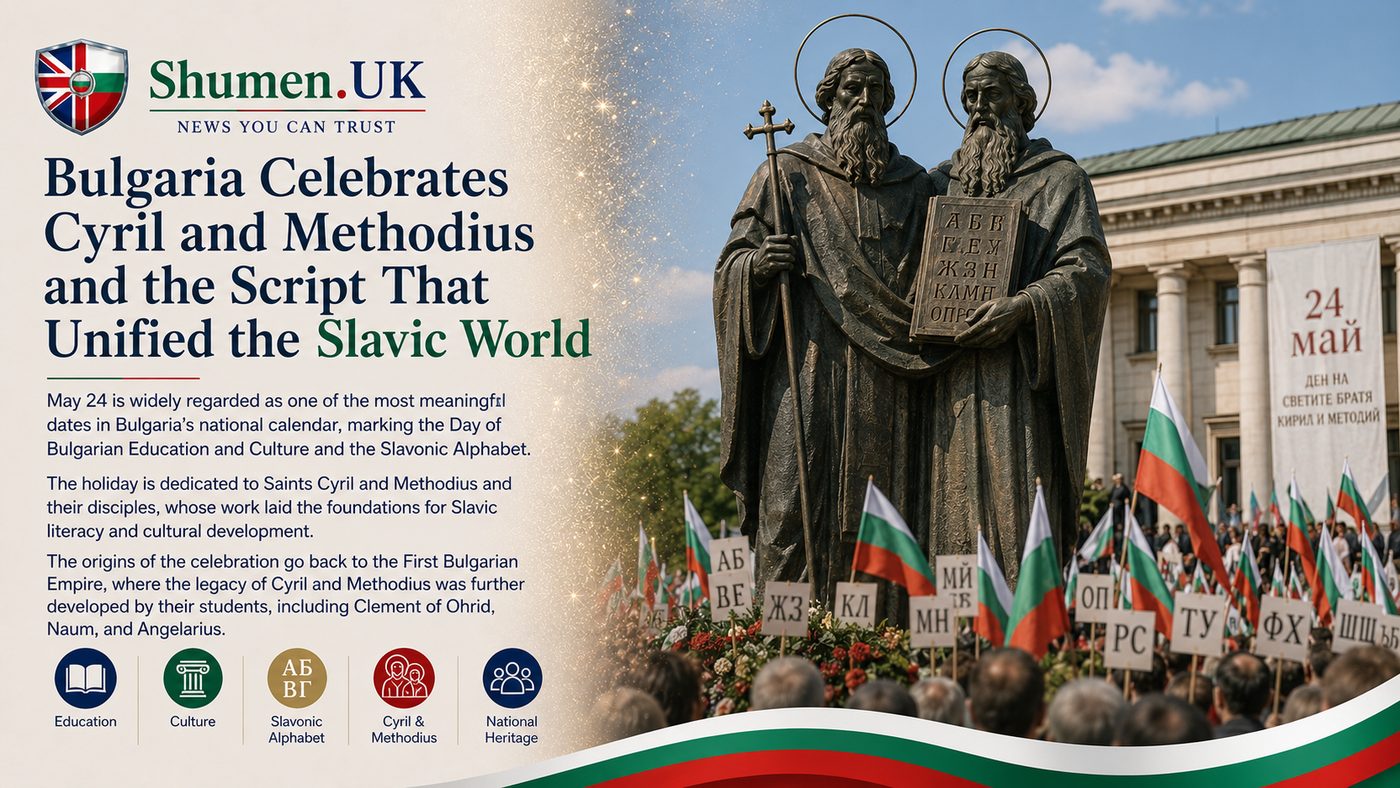
Bulgaria observed May 24 as the Day of Bulgarian Education and Culture, a statutory public holiday dedicated to Saints Cyril and Methodius and the creation of the first Slavic alphabet. Schools, universities and cultural institutions across the country held ceremonies, concerts and processions, with students carrying portraits of the two brothers and symbols of the Cyrillic script.
The Brothers Who Created Slavic Literacy
Cyril and Methodius, two Byzantine scholars working in the 9th century, created Glagolitic, the first alphabet designed specifically for Slavic languages. Their work was further developed by disciples including Clement of Ohrid, Naum and Angelarius in the First Bulgarian Empire.
In the literary schools of Preslav and Ohrid during the 9th and 10th centuries, Glagolitic was refined into what became the Cyrillic script. The new alphabet was designed to be more accessible and allowed religious texts to be translated into Slavic for the first time, making written knowledge available in the region's own language.
While Bulgaria played a central role in developing and preserving this written tradition, the script's evolution involved contributions from multiple Slavic cultures across Eastern Europe. The Preslav Literary School in particular became an important centre for producing translations, theological texts and original writings that shaped the intellectual foundations of Slavic civilisation.
A Script That Crossed Borders
Cyrillic spread far beyond medieval Bulgaria. It is now the writing system for Bulgaria, Serbia, Russia, Ukraine, Belarus and North Macedonia, as well as parts of Central Asia. The script remains central to Orthodox Christian liturgical texts and is used by over 250 million people worldwide.
The script's continued relevance highlights how a medieval innovation has evolved into a practical and widely used alphabet across multiple countries and languages. It has been adapted for digital technology and international use, though the technical details of this modernisation are beyond the scope of this article.
What This Means for British Expats
For British people living in Bulgaria, May 24 offers a window into one of the country's most significant cultural contributions. The holiday is widely observed, with public events, school closures and processions in most towns and cities.
May 24 is a statutory public holiday, meaning most government offices, banks and businesses are closed. The scale and formality of local celebrations can vary significantly depending on where you are, ranging from large organised processions in cities to quieter commemorations in smaller towns.
Bulgarian communities abroad, including in the UK, mark the day with cultural events that emphasise the connection between language and national identity. British expats interested in participating can typically find ceremonies at cultural centres or through expat community groups, though details vary by location.
For those planning errands or travel on May 24, it's worth noting that public services will be limited and transport schedules may be adjusted.
A Holiday Rooted in Education and Identity
Today's celebrations combine historical remembrance with contemporary performances, reinforcing the link between tradition and modern identity. Education remains at the core of the holiday, reflecting a long-held belief that literacy and knowledge are essential to social development.
Cultural historians note that the creation and development of the Slavic alphabet allowed entire communities to access written knowledge in their own language for the first time. This is widely seen as having contributed to the preservation of Slavic identity during periods of political and cultural pressure in medieval Europe, though the precise causal impact remains a matter of historical interpretation.
May 24 continues to hold a firm place in Bulgaria's cultural life, marking the intersection of history, language and education. It's one of those rare national holidays that manages to be both a celebration of the past and a statement about the country's place in the broader cultural history of Eastern Europe.
Whether you're caught off guard by the bank closure or deliberately seeking out a procession, it's a day when the usually quiet business of alphabets and literacy gets surprisingly loud public recognition.