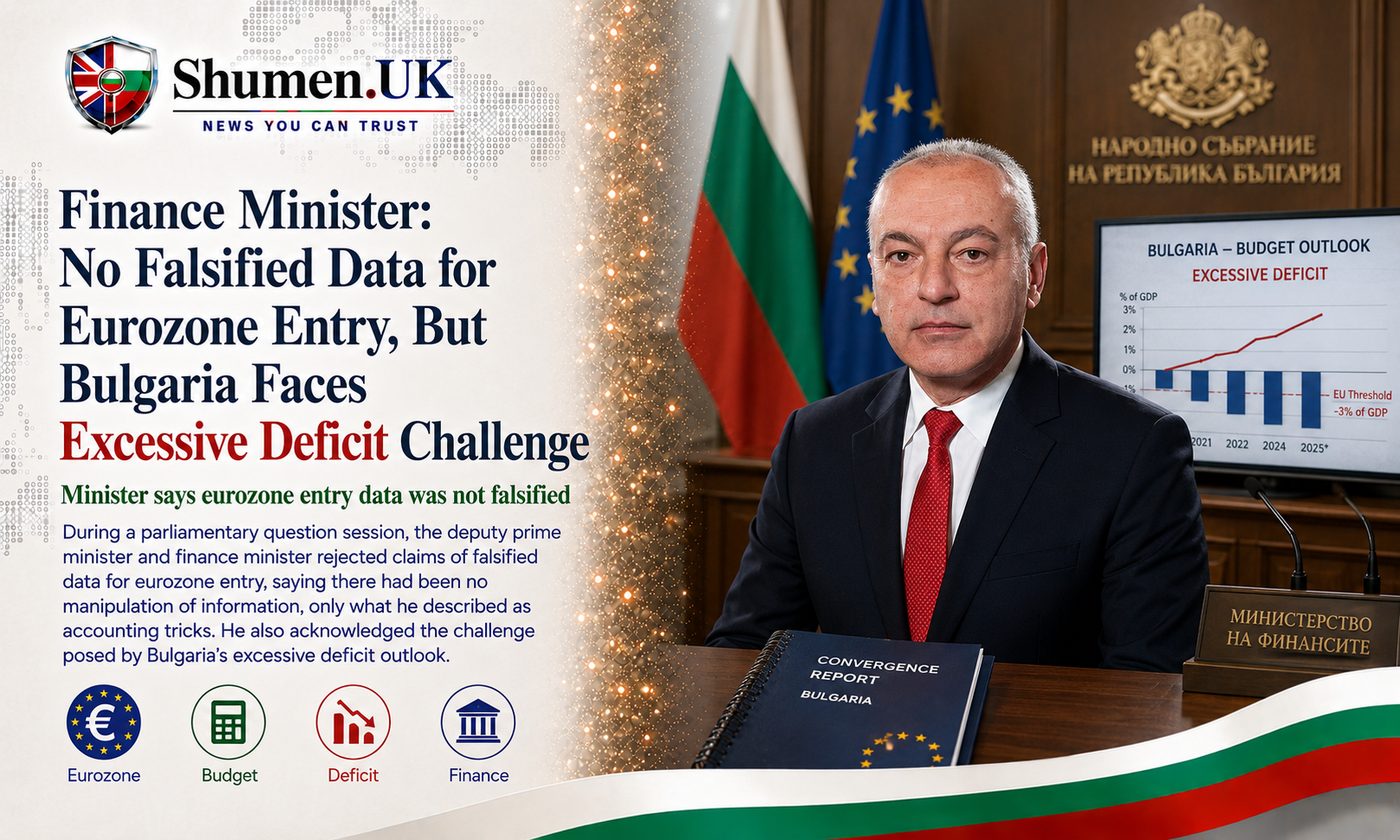
The Bulgarian government's 3% budget deficit target is looking increasingly theoretical. Finance Minister Galab Donev told parliament on 5 June that the final figure for 2026 will likely exceed that threshold, confirming what the European Commission has been saying for weeks.
The Commission's projections put Bulgaria's deficit at 4.1% of GDP this year and 4.3% in 2027. Donev did not dispute those numbers during a parliamentary oversight session attended by all four deputy prime ministers, though Prime Minister Rumen Radev stayed away.
The Numbers and the Contradictions
Donev rejected claims that Bulgaria falsified data to qualify for eurozone entry on 1 January 2026. Responding to Revival MP Tsoncho Ganev during the parliamentary session, he said there had been "no falsification, only accounting tricks". The distinction was not elaborated. This statement reflects Donev's position as delivered to parliament and has not been independently verified beyond his remarks.
GERB lawmaker Temenuzhka Petkova pressed him on a recent warning that the deficit could reach 7.4%, substantially higher than the Commission's 4.1-4.3% range. Donev offered no explanation for the discrepancy between these figures.
The Commission is expected to launch an excessive deficit procedure against Bulgaria and require net expenditure cuts of 0.5% of GDP. An excessive deficit procedure is the EU's enforcement mechanism when a member state breaches the 3% threshold. It brings Brussels scrutiny, sets fiscal consolidation targets, and can lead to sanctions if corrections are not made. Our money guide tracks what this means for British expats managing finances in Bulgaria, including how fiscal tightening could affect banking, pensions and currency stability.
Where the Money Goes
According to figures Donev presented to parliament, 76% of budget spending is on salaries, with capital expenditures accounting for 24%. These proportions come from his parliamentary testimony and have not been independently verified.
Donev confirmed that outstanding obligations on road infrastructure projects and municipal investments remain unpaid, without specifying amounts or timelines. Anyone who has driven the stretch of the Hemus motorway near Shumen lately will have noticed the static diggers and silent construction sites, a visible consequence of the payment backlog.
The government plans to submit the 2026 state budget by the end of June. In theory, the deficit target remains 3%. In practice, Donev said, ongoing calculations will determine by how much it is exceeded.
Just Transition Fund Audit Delays 1,100 Companies
Deputy Prime Minister Atanas Pekanov told parliament an extraordinary audit has been ordered into a Just Transition Fund programme for small and medium-sized businesses. The inspection followed concerns about project selection and procedure administration.
More than 1,100 companies have passed evaluation but are waiting for funding decisions while the review continues. The fund contains over €562 million earmarked for Bulgaria's coal-dependent regions, Pekanov said. Around 40% of available funding has been contracted; 7.5% has been disbursed.
GERB-affiliated MP Radoslav Ribarski noted the fund represents one of the most important investment sources for Stara Zagora, Pernik and Kyustendil, three regions heavily affected by coal industry decline. The parliamentary exchange did not clarify when the audit would conclude or when the 1,100 companies might receive decisions. These figures and the status of the audit are based solely on Pekanov's parliamentary remarks and have not been confirmed by external sources.
Healthcare Procurement and Water Negotiations
Democratic Bulgaria MP Alexander Simidchiev asked whether the Finance Ministry would support requiring private hospitals to conduct public procurement procedures when purchasing medicines. Donev avoided a direct answer, saying broader analysis of pricing policies was needed and that the National Health Insurance Fund should define relevant rules. No firm policy position was stated.
"We Continue the Change" leader Asen Vassilev questioned whether the government had prepared the macroeconomic framework for the budget, including GDP growth, inflation and consumption forecasts. Donev replied only that the indicators were expected to show growth. Vassilev stated his belief that state revenues could be approximately €7 billion higher this year, a claim Donev did not address.
Deputy Prime Minister Alexander Pulev told Revival leader Kostadin Kostadinov that negotiations with Greece over transboundary water management of the Arda River are underway. Pulev said the government would protect Bulgarian farmers' interests while maintaining constructive relations with Athens. The parliamentary statement has not been confirmed by external sources, and it is not clear what stage the negotiations have reached.
What This Means for British Expats
Bulgaria's fiscal position matters for British expats and businesses for several reasons. An excessive deficit procedure brings Brussels scrutiny and potential pressure for spending cuts or tax changes. The taxes guide covers Bulgaria's 10% flat tax system, which the European Commission has previously urged Sofia to reconsider.
Fiscal tightening could delay or reduce infrastructure spending, affect public services, and influence Bulgaria's attractiveness for investment. British businesses operating in or trading with Bulgaria should monitor whether the government's response involves tax policy changes or administrative fee increases.
Practically speaking, the euro keeps circulating and banks show no signs of strain. Bulgaria's residency rules and administrative processes are unaffected by fiscal policy debates, though any cuts to municipal budgets could slow processing times at local administrative centres if staffing is reduced. The medium-term impacts will depend on how the government responds to EU pressures, which remain uncertain at this stage. The government's stated intent to submit the 2026 budget by late June should provide more detail on where spending adjustments, if any, will fall.