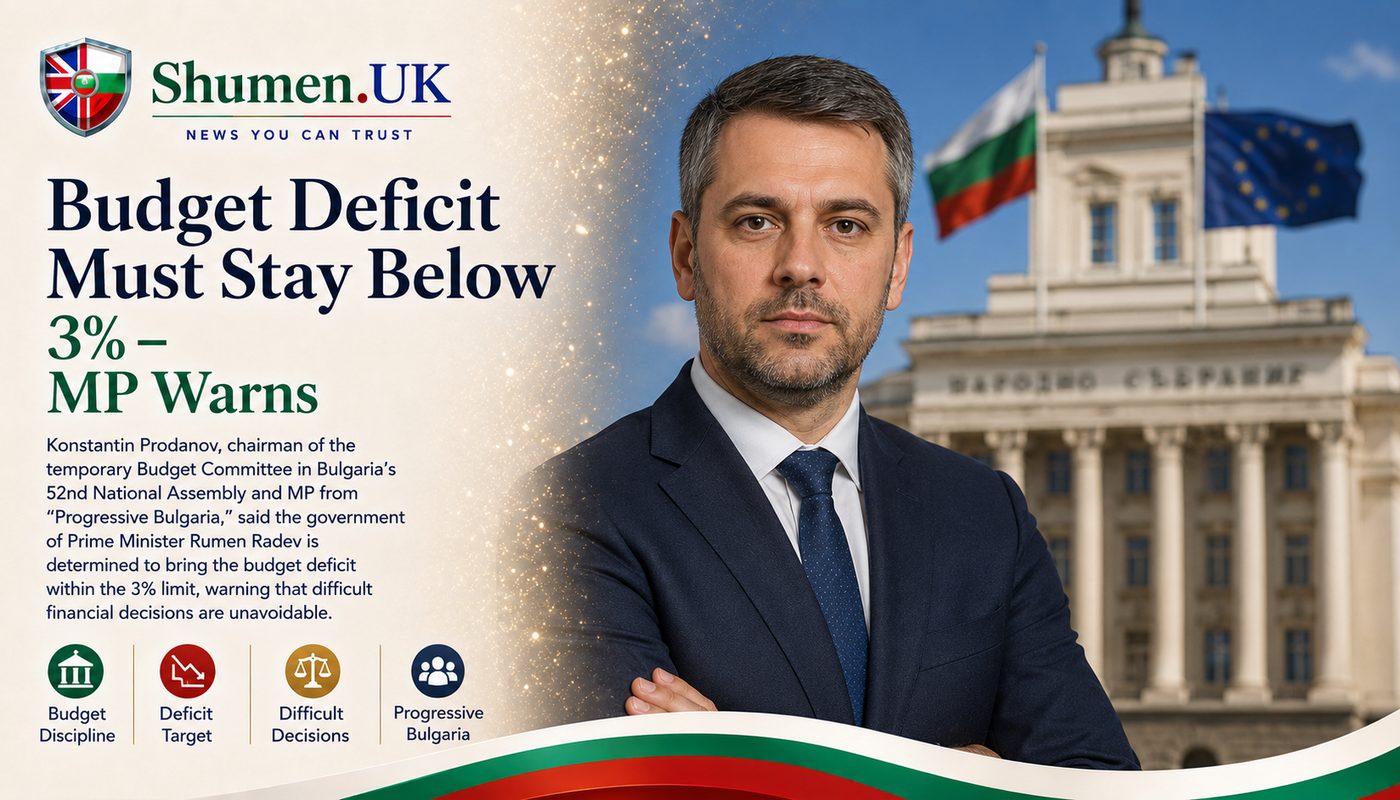
Bulgaria's government has ordered every ministry to cut spending by 10% starting 1 September, the latest move in what the ruling Progressive Bulgaria party admits will be a long and painful drive to bring the country's budget deficit under control.
The detail comes from Konstantin Prodanov, chair of the National Assembly's temporary Budget Committee and a Progressive Bulgaria MP. Speaking to Bulgarian National Television, Prodanov offered what is so far the most complete picture of the government's fiscal thinking, though his comments represent a political perspective rather than official government policy or independently verified economic data.
The Fiscal Picture According to Prodanov
Prodanov estimates the country is facing a €7 billion fiscal gap while holding a fiscal reserve of just €6.8 billion. That gap is roughly equal to the entire reserve, a situation he described as untenable without debt financing.
"Debt is inevitable at the moment," Prodanov said, arguing that the question is not whether Bulgaria should borrow, but when. He recommended borrowing sooner rather than later while market conditions remain relatively favourable, and suggested issuing part of the debt domestically to help absorb liquidity and act as an anti-inflationary tool.
The government is aiming to bring the budget deficit within the EU's 3% limit, a target Prodanov said is formally stated in Progressive Bulgaria's governing programme. The party came to power following Bulgaria's eighth parliamentary election in five years.
These fiscal figures, the characterisation of market conditions, and the assessment of Bulgaria's labour market as "overheated" are all Prodanov's statements rather than official government data. The Bulgarian National Bank, the Finance Ministry, and independent economic institutions have not publicly confirmed these figures or assessments.
What the Cuts Mean
The 10% spending reduction applies across all ministries and takes effect from 1 September 2026. Salaries are protected under the plan, Prodanov confirmed, with cuts to come through downsizing and administrative restructuring rather than wage freezes or direct pay cuts.
"We are not talking about reducing salaries," Prodanov said. "The reductions will come through staffing optimisation."
Exactly which ministries will bear the deepest cuts, how many jobs will go, or what "optimisation" looks like in practice has not been disclosed. The government is banking on what Prodanov described as an overheated labour market to absorb displaced public sector workers. "People who enter the market now can relatively easily find work," he said.
That characterisation of the labour market is Prodanov's view and has not been corroborated with official employment statistics from the National Statistical Institute or Eurostat. Whether Bulgaria's employment picture will remain tight enough to absorb public sector redundancies without social backlash is an open question, and one the government's calculus depends on rather heavily.
What's Protected (According to the Government)
Despite the broader austerity drive, Prodanov insisted that capital investments will remain a priority in the new budget. "They will not be cut," he said, signalling that infrastructure and development spending would continue even as day-to-day ministry operations face tighter discipline.
Prodanov also warned explicitly against using the €6.8 billion fiscal reserve to cover current obligations. "I would not recommend spending the fiscal reserve," he said, treating the reserve as a buffer to be preserved rather than a pot to be emptied.
These are stated policy commitments from the ruling party. Whether budget reality allows both protection of capital spending and avoidance of reserve drawdown while cutting ministry operations by 10% remains to be tested once detailed budget proposals are published.
What This Means for British Expats
For British expats in Bulgaria, the most immediate concern is the potential for slower or disrupted public services as ministries shed staff and tighten budgets. Residency applications, address registration, driving licence exchanges, and other bureaucratic processes that already test patience may face further delays if administrative capacity is reduced.
This is not certain. It depends entirely on how the cuts are implemented and whether front-line services are protected. But the direction of travel suggests caution is warranted, particularly for anyone with pending applications or renewals.
The assurance that capital investment will continue is more relevant to property owners and businesses than to individuals navigating the state machine. Infrastructure projects continuing suggests the roads and utilities picture may remain stable, but front-line bureaucratic capacity is where British nationals are most likely to feel any pinch.
Bulgaria's plan to borrow domestically to absorb liquidity and limit inflation is presented by Prodanov as a signal that the government sees price stability as a priority. That would benefit British expats living on UK pensions or foreign income. That said, any economic instability triggered by austerity, particularly if labour unrest follows the job cuts, could affect everything from property values to the cost of utilities and services.
The government's claim that the labour market will absorb displaced workers without social tension is optimistic. If that calculation proves wrong, the knock-on effects could be felt across the economy. British expats should monitor how the cuts play out over the coming months and be prepared for potential disruption to both public services and the broader economic climate.
The Longer View
Prodanov framed the cuts as the start of a process, not a one-off adjustment. "These measures are only the beginning, not the end," he said, indicating that further optimisation and budget discipline will follow once the government has a clearer picture of where the fiscal shortfall sits.
The commitment to bringing the deficit under 3% is an EU requirement, not just a political ambition, and Progressive Bulgaria's governing programme makes that target explicit. Prodanov argued that deficits should be used strategically, with governments accumulating reserves during strong years to cushion against downturns. "In good years, we should strive for a deficit close to zero," he said.
All of this is reasonable fiscal theory. Whether the political will exists to see it through, and whether the social cost proves manageable, are questions that will be answered over the coming months as the cuts take effect and the borrowing begins.