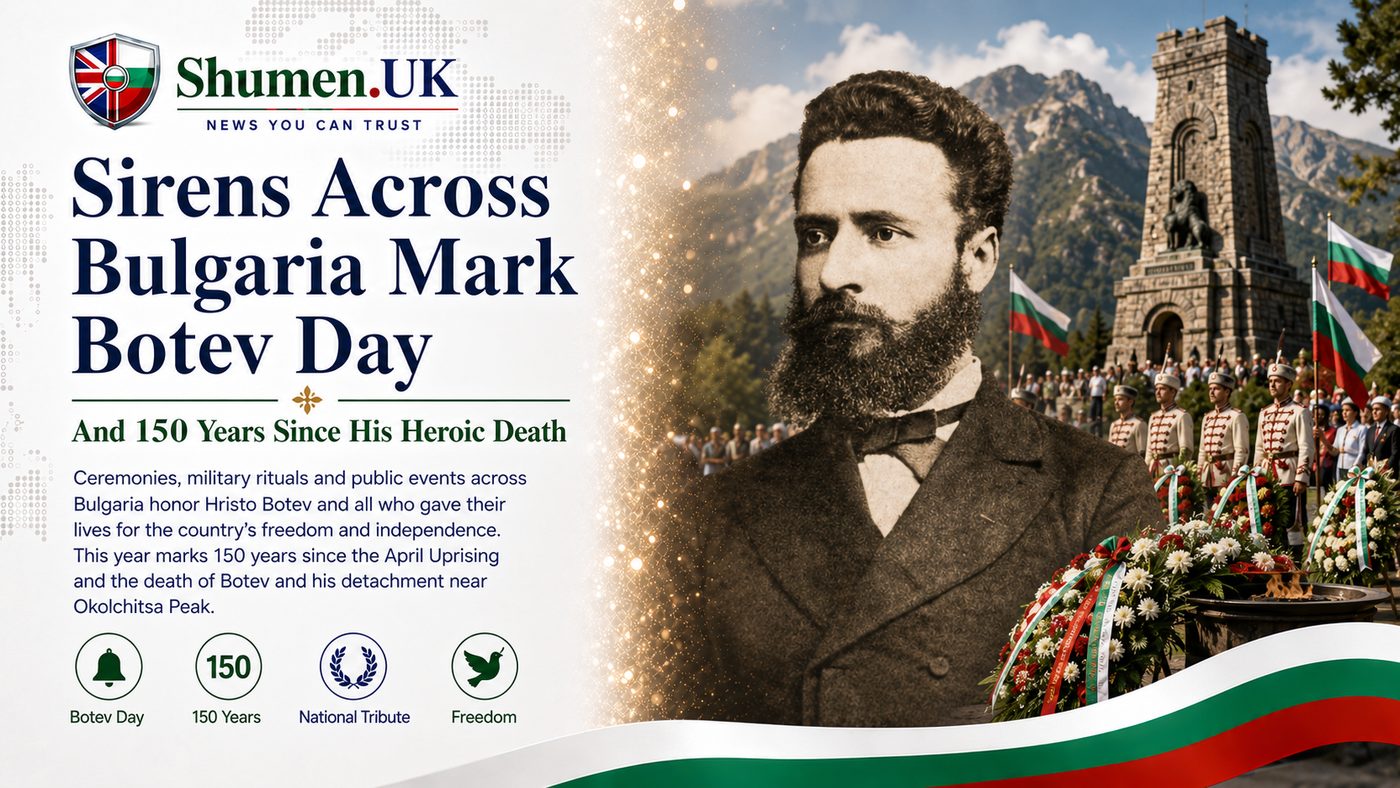
At noon on Monday, sirens sounded across Bulgaria for two minutes. Traffic stopped, pedestrians paused mid-stride, and the country observed a moment of silence honouring those who died for national freedom. The tradition repeats each year on Botev Day, but this year carried particular weight: 2026 marks 150 years since revolutionary poet Hristo Botev and his detachment were killed near Okolchitsa Peak during the April Uprising of 1876.
For British expats in Bulgaria, the siren is a national ritual worth knowing. Citizens are expected to stop whatever they are doing when it sounds. Shops, offices and streets briefly fall silent. The observance is serious and widely respected.
Okolchitsa and the Pilgrimage Route
The day's centrepiece remains the annual pilgrimage to Mount Okolchitsa, where Botev and his fighters made their final stand. More than 1,800 participants completed the march retracing the historic route from Kozloduy on the Danube to Okolchitsa, according to Novinite.com. A broader commemorative trek following the route of the revolutionary force drew over 2,000 people in total.
Historical reenactments at Okolchitsa depicted key moments from Botev's campaign, including battles and the death of the revolutionary leader. Participants interviewed during the events said they remained inspired by the courage and sacrifice shown by the fighters.
Who Was Hristo Botev?
Botev was a revolutionary, poet and journalist who participated in the Bulgarian revolutionary movement as a member of the Bulgarian Revolutionary Central Committee. He is widely honoured in Bulgaria for his role in the struggle against Ottoman rule. He died on 2 June 1876 near Okolchitsa during the April Uprising, a key moment in Bulgaria's fight for independence.
The April Uprising itself, though crushed by Ottoman forces, drew international attention to Bulgarian suffering under Ottoman rule and contributed to the eventual Russian intervention that led to Bulgarian liberation in 1878. The 150th anniversary of these events explains the scale of this year's commemorations.
Ceremonies in Sofia and Nationwide
In Sofia, a solemn ceremony took place in front of Botev's bust monument in Borisova Garden, while similar commemorations were held in towns and cities throughout the country. The events reflected a long-standing tradition of honouring both Botev and all Bulgarians who fought and died for national independence.
What This Means for British Expats
British expats in Bulgaria will encounter Botev Day as one of the most visible national commemorations on the calendar. Unlike some public holidays that pass quietly, Botev Day involves a nationwide pause, significant public gatherings, and road closures near major commemorative sites.
The two-minute siren at noon is the most immediate disruption: if you are mid-conversation, mid-commute, or mid-transaction when it sounds, expect a brief halt. Shops typically close briefly, street traffic stops, and conversations pause. It is appropriate to stop and observe out of respect for local custom, though there is no legal obligation.
The commemorations also offer insight into Bulgarian national identity. Botev's legacy sits at the intersection of revolutionary history, literary culture and patriotic symbolism. Understanding why the country stops for two minutes each 2 June provides useful context for anyone navigating Bulgarian public life.
Historical Context: The April Uprising and Botev's Death
The April Uprising of 1876 was an organised but ultimately unsuccessful attempt by Bulgarian revolutionaries to overthrow Ottoman rule. Ottoman forces suppressed the uprising brutally, which drew widespread condemnation across Europe and contributed to the Russo-Turkish War of 1877-1878. That war ended with the Treaty of San Stefano and eventually the Congress of Berlin, which established Bulgarian autonomy.
Botev crossed the Danube from Romania with a small detachment of approximately 200 fighters on the steamship Radetzky in May 1876, landing near Kozloduy. His group marched south, engaging Ottoman forces several times before being ambushed near Okolchitsa on 2 June 1876. Botev was killed during the battle. His death at the age of 28 cemented his place as a national martyr.
The 150th anniversary has drawn particularly large numbers of participants to this year's commemorative events, reflecting ongoing reverence for Botev's legacy.
Practical Notes
The two-minute siren at noon is the main practical consideration for British nationals in Bulgaria. No broader disruption to banking, transport or services accompanies Botev Day itself, though road closures near Okolchitsa and other commemorative sites may affect travel in those specific areas.
For British expats interested in Bulgarian history, Botev Day offers a window into how the country memorialises its revolutionary past. The tradition has persisted across multiple political regimes and remains a fixture of the national calendar.