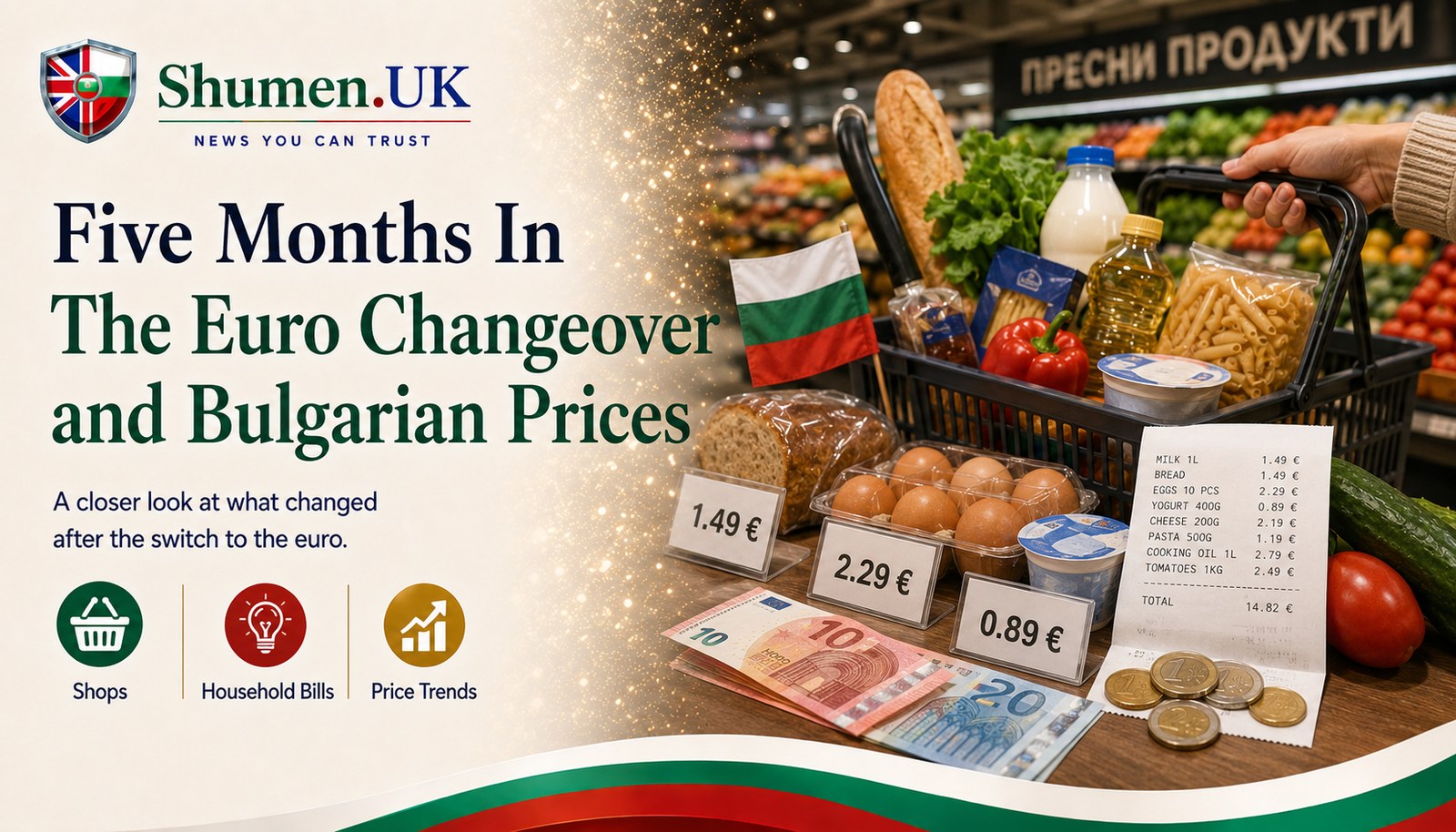
What Actually Changed on 1 January 2026
The mechanics of the switch were unglamorous, which is exactly what a central bank wants.
Bulgaria joined the eurozone on 1 January 2026, replacing the lev at the long-fixed conversion rate of 1 euro to 1.95583 leva. That rate had been locked in for years under the currency board, so for the Bulgarian National Bank and the commercial banks the changeover was essentially an accounting event rather than a monetary one. Prices in shops, on payslips, in rental contracts and on utility bills were converted by that exact ratio, with the legally required dual display of leva and euros running through the months either side of the switch.
For a British expat already living here, the practical experience was thin. Cards kept working. ATMs dispensed euro notes from day one. Standing orders rolled over. The lev ceased to be legal tender within the standard short window after adoption, although the central bank continues to exchange old notes for an extended period.
What the European Central Bank flagged in its April 2026 review, and what most people in Bulgaria have noticed on the ground, is that the changeover itself behaved well. The drama, such as it is, sits in the gap between the official conversion and what individual businesses chose to charge once the price tags came down and went back up in euros.
Where Prices Held: The Boring Good News
The bulk of a normal household budget did not move much.
If you do most of your shopping in the larger supermarket chains, fill up at branded fuel stations, and pay utilities by direct debit, your monthly outgoings in euros today should look almost identical to your monthly outgoings in leva last autumn, once you do the 1.95583 conversion.
This is not an accident. Three forces pushed in the same direction:
- Regulated pricing. Electricity, water, district heating and a swathe of telecoms tariffs are set or supervised by Bulgarian regulators. There was no scope for a sneaky euro-era reset.
- Big-chain self-interest. Kaufland, Lidl, Billa, Fantastico and the major fuel brands ran heavy "price freeze" marketing across the changeover. They knew shoppers would be watching, and they had the scale to absorb any small rounding losses internally.
- Dual display. The legal requirement to show both currencies for months either side of the switch made suspicious moves obvious. A shelf tag that read 1.95 leva in November could not credibly become 1.20 euros in February.
The net effect: a weekly supermarket shop, a tank of fuel, a mobile contract and an electricity bill behave today exactly as the maths says they should. Anyone who tells you the supermarkets quietly hiked across the board is, on the available evidence, wrong. That doesn't mean nothing happened. It means the action was elsewhere.
Where Prices Drifted: The Coffee, the Haircut, the Plumber
Unregulated, cash-friendly services are where the quiet mark-ups landed.
The pattern the ECB sketched in April, and that most expat groups have been comparing notes on since spring, is consistent. The price creep showed up in services where:
- The transaction is small.
- The provider is independent rather than part of a chain.
- The customer pays often enough not to dig out old receipts.
- The pre-changeover price ended in an awkward number once divided by 1.95583.
The classic example is the café espresso. A coffee that was 2.40 leva in December converts to 1.23 euros. A surprising number of cafés now charge 1.50 euros, sometimes 1.60. That is not rounding, that is a 22 to 30 percent increase wearing a rounding costume.
The same logic applied to barbers, nail salons, small neighbourhood restaurants, taxi base fares in some cities, market traders selling produce by the kilo, and a slice of the independent tradesman economy where quotes are verbal. Rents on new lets in expat-popular areas drifted in the same direction, although existing contracts converted cleanly.
None of this is uniform. Plenty of cafés held their prices honestly. Plenty of barbers did the maths properly. But the asymmetry is real: where rounding happened, it almost always rounded up.
Why Rounding Went Up, Not Down
There is a behavioural logic here, not a conspiracy.
If you run a small café, your old menu was built around lev prices ending in zero or fifty stotinki. Those are the prices that feel right in cash, that match the coins in the till, that customers expect. When you redenominate in euros, you face a choice. You can print a menu full of prices like 1.23, 2.81, 4.09. Or you can pick the nearest "clean" euro number.
Clean euro numbers are 1.00, 1.20, 1.50, 2.00, 2.50. They are almost never lower than the precise converted figure. The psychology of menu design pushes operators upward, not downward, every time.
Multiply that across thousands of independent businesses and you get exactly what the ECB observed: a measurable, one-off bump in service-sector prices concentrated in the first weeks after the switch, with little subsequent correction because nobody lowers a menu price once it is printed.
This is the same pattern documented in every previous eurozone accession, from the original 1999 cohort onward. Bulgaria is not unusual. The size of the effect appears modest in the aggregate inflation figures, but it is very visible to anyone living their daily life in cafés and small shops.
What This Means for British Expats
Mostly: nothing structural, but a few habits are worth changing.
If you arrived in Bulgaria before the changeover, your standing costs are stable. Your rent, if you had a contract running across 1 January, converted at the official rate. Your utility bills behave normally. Your pension or salary lands in the same bank account and buys roughly the same shopping basket.
Where you will notice the changeover is in the discretionary, small-ticket end of life. The coffee you used to round to 2.50 leva without thinking is now 1.50 euros without thinking, and that is a real-terms increase you absorbed by default. Over a year, across all the small purchases, it adds up to a non-trivial sum.
The practical adjustments are simple:
- Re-baseline mentally. Stop converting euro prices back into leva in your head. That instinct flatters Bulgarian prices to a UK eye and obscures the local mark-ups. Compare euros to euros.
- Notice your regulars. The café, barber and lunch spot you visit weekly are where mark-ups bite hardest. If a regular has clearly rounded up, you have a choice: accept it, switch, or push back politely.
- Discount old online guides. Any blog or forum post from 2024 or earlier quoting Bulgarian prices in leva is now misleading. Mental conversion does not capture the rounding effect. Treat pre-2026 price guides as directional only.
- Carry less cash than you used to. Card acceptance has broadened with the euro switch, and card payments are the easiest way to keep a running record if you later want to query something.
Using the KZP Complaint Route (And Why Almost Nobody Does)
Bulgaria has a consumer protection body. It accepts complaints. It is barely used by foreigners.
The Commission for Consumer Protection (Komisia za Zashtita na Potrebitelite, KZP) is the state body that handles unfair commercial practices, including suspicious rounding around the euro changeover. It published guidance through 2025 and 2026 explicitly inviting complaints where a business appeared to have raised prices using the currency switch as cover.
The process exists. In practice, very few British expats use it, for understandable reasons:
- The complaint form is in Bulgarian.
- Evidence works best as paired receipts or photographs showing the same item before and after the changeover.
- The penalties are administrative, not restitutionary; you will not get your euro back, but the business may face a fine.
- The benefit is collective rather than individual, which doesn't motivate one-off complainants.
If you do want to file, the realistic approach is to ask a Bulgarian-speaking friend, a paid translator, or your local citizens' advice equivalent to help draft the submission. Attach photos. Be specific about the item, the old lev price, the new euro price, the dates, and the address of the business.
The more useful exercise for most readers is to keep informal evidence. Photograph menus when you spot something egregious. Share it in your local expat group. Word of mouth has been a more effective discipline on Bulgarian small businesses through 2026 than the formal complaint mechanism, and a café that loses its regulars is more likely to revisit its prices than one that gets a letter from Sofia.
For Brits Considering a Move: What to Budget In
If you are still planning your move, the changeover simplifies your sums rather than complicating them.
The honest answer to "is Bulgaria still cheap" five months after the euro switch is: yes, comfortably, but slightly less so in the bits of daily life that British arrivals tend to notice first.
The big-ticket items that drive a move decision behave well. Rent in Shumen and most cities outside Sofia remains a fraction of UK levels. Utilities are genuinely low by Western European standards. Supermarket food, the GP visit (with GHIC for visitors or full coverage once you are on the Bulgarian system), local transport, fuel, internet, all of these are roughly where the maths predicts they would be.
The areas where the changeover bit hardest are also the areas where a recent arrival is most exposed: the daily coffee, the casual lunch, the haircut, the taxi for the first few months before you learn the bus routes. Budget those in euros at the post-changeover rate rather than at any lev-era figure you have read online, and you will avoid the small but real shock of discovering the numbers no longer match.
A sensible discipline if you are house-hunting now is to ask landlords and estate agents for prices in euros and ignore any leva conversion they offer. The lev is no longer legal tender. Pricing in euros is the only relevant comparison, both for negotiating and for thinking about your own finances back in sterling.
What the ECB April Review Actually Said
It is worth being precise about the official position, because it has been over-interpreted in both directions.
The European Central Bank's April 2026 commentary on Bulgaria's accession was, in the central-bank way, mild. It described the changeover mechanics as smooth, the inflation impact as modest in aggregate, and the price behaviour in unregulated services as showing a pattern consistent with previous eurozone accessions: small upward rounding concentrated in the first months, fading thereafter.
It did not describe a crisis. It also did not pretend nothing had happened. Both the Bulgarian press and some UK-facing commentary picked one half of that message and ran with it. The reality, for someone living here, sits where the ECB put it: the macro picture is fine, the micro picture has some honest grumbles, and the medium-term trajectory looks like every other eurozone accession on record.
If you were waiting for the changeover to settle before deciding whether the country was still a sensible place to live or move to, the answer five months in is that nothing fundamental has shifted. The currency is more convenient for anyone moving money in from the UK or the rest of the EU. The cost of living is still well below British levels. The mark-ups that did happen are bounded, visible, and largely avoidable once you know where to look.